Why Are Gummies Better Than Tablets? Benefits & Differences
Discover the potential benefits of gummy vitamins compared with tablets. Learn about taste, convenience, nutrient absorption, sugar content, supplement safety, and how to choose the right format for your daily wellness routine.
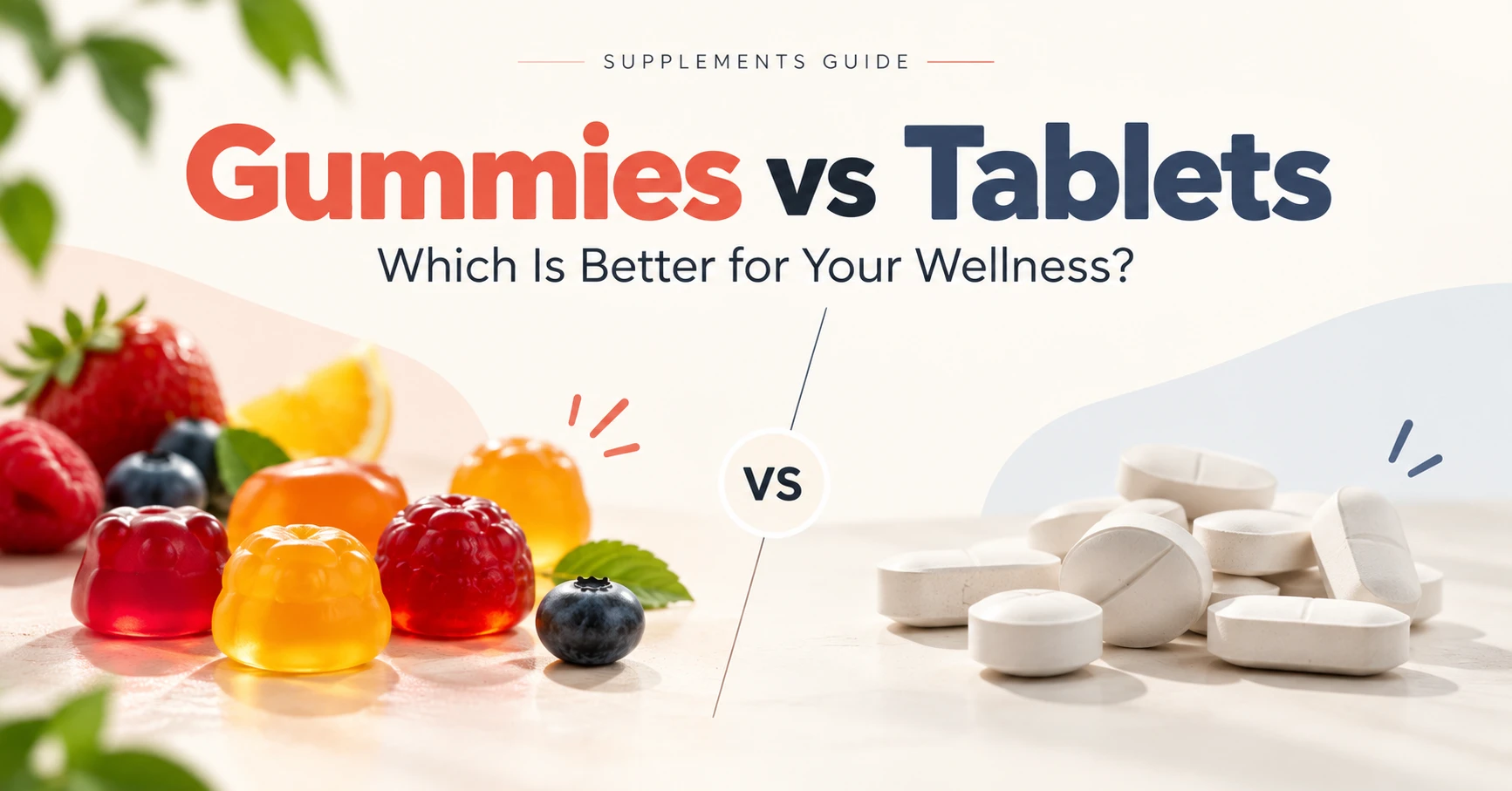
Why Are Gummies Better Than Tablets? Benefits, Differences & How to Choose
Vitamins and dietary supplements are available in many forms, including tablets, capsules, powders, liquids, and gummies. While tablets have been a popular choice for years, gummy supplements have become an appealing option for people who prefer a chewable and flavourful way to take their daily nutrients.
But what makes gummies different from tablets? Are gummies easier to take? Do they provide the same nutritional benefits? And which option is right for your daily wellness routine?
In this guide, we explore the differences between gummies and tablets, their potential advantages, important limitations, and the factors to consider before choosing a supplement.
1. What Are Vitamin Gummies?
Vitamin gummies are chewable dietary supplements formulated with selected vitamins, minerals, or other nutritional ingredients. They are designed to be chewed rather than swallowed whole and are often available in fruit-inspired flavours and different shapes.
Depending on the formulation, gummies may contain nutrients such as vitamin C, vitamin D, vitamin B12, biotin, zinc, or a combination of vitamins and minerals.
Their popularity comes partly from their convenient format and pleasant taste. For people who dislike swallowing pills, gummies can offer a more approachable way to take certain supplements.
However, ingredients and nutritional amounts differ between products, so it is important to read the label rather than assume all gummies provide the same nutrients.
2. What Are Vitamin Tablets?
Vitamin tablets are solid oral supplements made by compressing powdered ingredients into a specific shape. Some tablets have coatings to make them easier to swallow or to help control how they dissolve.
Tablets can contain individual nutrients, such as vitamin D or iron, or a combination of vitamins and minerals in a multivitamin formula.
One advantage of tablets is that their compact format can accommodate certain nutrient combinations and dosages efficiently. They may also contain little or no added sugar, depending on the formulation.
Tablets remain a practical option for many people. The best choice depends on the ingredients required, the recommended dosage, personal preferences, and any relevant health considerations.
3. Gummies vs Tablets: What Is the Difference?
| Feature | Gummies | Tablets |
|---|---|---|
| Consumption | Chewed before swallowing | Usually swallowed with water |
| Taste | Often fruit-flavoured | May have a neutral, bitter, or mineral-like taste |
| Ease of use | May suit people who dislike swallowing pills | May be difficult for some people to swallow |
| Nutrient formulation | Some nutrients and dosages may be harder to accommodate | Can accommodate a wide range of nutrients and dosages |
| Added sugar | May contain sugar or other sweeteners | Often available with little or no sugar |
| Portability | Convenient, but can be sensitive to heat and moisture | Often compact and practical to carry |
| Nutrient absorption | Depends on the nutrient and specific formulation | Depends on the nutrient and specific formulation |
| Best suited for | People who prefer a chewable supplement | People who prefer a conventional pill or need a particular formulation |
Neither format is universally better. Both can provide useful nutrients when appropriately formulated and used according to directions.
4. Seven Potential Advantages of Gummies Over Tablets
1. Easier for People Who Dislike Swallowing Pills
One of the main advantages of gummies is their chewable format.
Some people experience difficulty or discomfort when swallowing tablets. A properly designed gummy may be easier for them to consume because it does not need to be swallowed whole.
This can be especially helpful for adults who prefer alternatives to conventional pills. However, gummies are not suitable for everyone, and people with swallowing difficulties should seek professional advice about an appropriate supplement format.
2. A More Enjoyable Taste
Many vitamin tablets have a noticeable mineral taste or may leave an unpleasant aftertaste. Gummies often use fruit flavours and sweeteners to make the experience more pleasant.
For people who dislike the taste of certain supplements, flavour can be an important factor when choosing a format they are comfortable taking.
Nevertheless, a pleasant taste does not mean a supplement is more nutritious or more effective. The ingredient list and nutrient amounts remain the most important considerations.
3. A Convenient Daily Routine
A supplement is useful only when it is appropriate for your needs and taken correctly. A format that fits naturally into your routine may be easier to maintain.
For someone who dislikes swallowing pills, a chewable gummy may feel more convenient and less intimidating.
Following the recommended serving instructions, keeping the product in a suitable place, and maintaining a consistent routine can help with responsible supplement use.
4. A More Approachable Format for Some Users
Gummies are often visually appealing and available in different shapes and flavours. This can make the format feel less medicinal to people who are uncomfortable with traditional tablets.
However, gummies are still dietary supplements, not ordinary sweets. They should always be used according to their label, and children should take them only when the product is appropriate for their age and under suitable adult supervision.
5. Flexible Formulation Options
Gummies can deliver selected vitamins, minerals, and other ingredients in a chewable format.
However, their composition depends on formulation constraints. There is limited space in each gummy, and the amount of active ingredients, texture, stability, and taste can affect what a manufacturer can include.
Tablets may be a better option for certain high-dose nutrients or complex mineral combinations. The correct choice depends on the nutritional goal rather than the format alone.
6. A Useful Alternative for Certain Supplement Needs
Gummies can be useful when a particular gummy formulation provides the nutrient and dose a person needs.
For example, someone looking for a chewable multivitamin may prefer a gummy if it contains the appropriate nutrients in suitable amounts. Another person who needs a specific mineral dose may find that a tablet is more appropriate.
The important point is to select the right formulation for the intended purpose instead of choosing solely by appearance or taste.
7. More Choice in Flavours and Formats
Gummy supplements are available in a variety of flavours and formulations, allowing consumers to choose products that suit their preferences.
This variety can make shopping for supplements more approachable. However, compare products carefully because two gummies marketed for the same purpose may contain different ingredients, serving sizes, sweeteners, and nutrient amounts.
5. Are Gummies More Effective Than Tablets?
This is one of the most important questions to consider.
Gummies are not automatically more effective than tablets. The body's ability to absorb a nutrient depends on several factors, including the specific nutrient, its chemical form, the product's formulation, how it dissolves, and individual health factors.
Some research has compared the absorption of particular nutrients from gummy and tablet formulations. Findings from small studies suggest that absorption can be similar for some nutrients and may differ for others. These results do not establish that all gummies are absorbed better than all tablets.
For example, a small pilot study comparing a multivitamin gummy with a tablet found broadly similar absorption measures for vitamins E and B12, while some measures for folate differed. The study was small, so its findings should not be generalised to every supplement. Read the study.
When choosing a supplement, consider the nutrient, dose, formulation quality, and suitability for your needs. The word “gummy” alone does not tell you how effective a product will be.
6. Do Gummies Contain Sugar?
Some gummies contain added sugar to improve their taste and texture. Others use sugar alcohols or alternative sweeteners, while some are formulated without sugar.
Tablets, in contrast, are often available with little or no sugar.
If you monitor your sugar intake, have diabetes, or simply prefer to avoid added sugar, check the nutrition information and ingredients list before buying a gummy supplement.
Look for:
- Total sugar per serving
- Total carbohydrates
- Sweeteners used
- Serving size
- Nutrient amounts per serving
Remember that “sugar-free” does not necessarily mean calorie-free, carbohydrate-free, or free from all sweeteners. Always check the actual label.
7. Are Gummies Suitable for Everyone?
Not necessarily. Although gummies may be convenient for some people, tablets or other formats may be more suitable for others.
Adults
Adults can choose between gummies and tablets based on their nutritional needs, preferences, and ability to take the product correctly.
Children
Some supplements are specifically formulated for children, but not every gummy is suitable for every age group. Follow the product's age guidance and serving directions, and supervise children when appropriate.
Gummies can look like sweets, creating a risk of accidental overconsumption. Store all supplements securely out of children's reach.
People With Dietary Restrictions
Check the ingredient list for allergens, gelatin, sweeteners, and other ingredients that may not suit your dietary requirements. Formulations vary, so do not assume that all gummies are vegan, vegetarian, gelatin-free, or free from particular allergens.
People Taking Medication
Certain nutrients and herbal ingredients can interact with medicines or may be unsuitable for specific health conditions. Ask a qualified healthcare professional whether a supplement is appropriate for you.
8. Important Things to Check Before Buying Gummies
Before choosing gummy vitamins, consider these factors:
Ingredient transparency: Choose a product that clearly lists its ingredients and the amount of each nutrient per serving.
Appropriate dosage: Compare the amount provided with your nutritional needs. Taking more than recommended does not necessarily provide extra benefits.
Quality and manufacturing: Look for clear manufacturer details, batch information, storage instructions, and applicable quality or regulatory information.
Dietary suitability: Check whether the product meets your requirements regarding sugar, sweeteners, gelatin, allergens, and other ingredients.
Storage requirements: Heat and moisture can affect the texture and quality of some gummies. Follow the label's storage instructions.
Professional guidance: If you have a medical condition, take medication, are pregnant or breastfeeding, or need a high-dose nutrient, consult a healthcare professional before starting a supplement.
9. Common Myths About Gummies and Tablets
Myth 1: Gummies are always absorbed faster.
Fact: Absorption depends on the nutrient and formulation. Gummies are not automatically faster or better absorbed than tablets.
Myth 2: Gummies are healthier because they taste better.
Fact: Taste is a matter of preference. Nutrient amounts, ingredients, quality, and suitability determine whether a supplement is appropriate.
Myth 3: Tablets are always stronger than gummies.
Fact: Tablets can accommodate certain high-dose formulations, but strength depends on the actual amount of each nutrient in the product.
Myth 4: Sugar-free gummies are always the best choice.
Fact: Sugar content is one factor to consider, but the full ingredient list, nutrient dosage, and suitability also matter.
Myth 5: Taking gummies every day guarantees better health.
Fact: Supplements can help meet specific nutritional needs, but they do not guarantee particular health outcomes and cannot replace a varied, balanced diet.
10. Gummies or Tablets: Which Should You Choose?
Choose the format that fits your nutritional requirements and daily routine.
Gummies may be worth considering if:
- You dislike swallowing conventional pills.
- You prefer a chewable format.
- You have found a product with suitable ingredients and nutrient amounts.
- You are comfortable with its sweeteners, sugar content, and serving instructions.
Tablets may be worth considering if:
- You need a specific or higher dose of a nutrient.
- You prefer to avoid added sugar.
- You want a compact supplement format.
- Your healthcare professional recommends a particular tablet formulation.
If neither format is suitable, other options such as liquids or powders may be available. A healthcare professional can help you choose an appropriate form when you have specific nutritional or medical needs.
Frequently Asked Questions
Are gummy vitamins as good as tablets?
They can be suitable alternatives when they provide the appropriate nutrients in appropriate amounts. Neither format is universally superior, and absorption varies by nutrient and formulation.
Can I take gummy vitamins every day?
Follow the serving instructions on the label. Whether daily supplementation is appropriate depends on the product, your diet, your nutritional needs, and your health circumstances.
Do gummy vitamins work without food?
This depends on the product and its ingredients. Some supplements are best taken with food, while others have different directions. Follow the product label or your healthcare professional's advice.
Why are gummies often more expensive?
Price depends on ingredients, manufacturing processes, packaging, serving size, brand positioning, and distribution. A higher price does not automatically mean a supplement is more effective.
Can I take gummies and tablets together?
Avoid combining supplements without checking their ingredients and doses. Taking both may lead to excessive intake of overlapping vitamins or minerals. Ask a healthcare professional or pharmacist if you are unsure.
Are sugar-free gummies better than regular gummies?
They may be preferable for people who want to limit added sugar, but compare the full ingredient list, sweeteners, dosage, and nutritional information before choosing.
Conclusion: Choose the Supplement That Fits Your Needs
Gummies offer a convenient, chewable, and often flavourful alternative to traditional vitamin tablets. For people who dislike swallowing pills, they may make taking certain supplements more comfortable and approachable.
However, tablets remain an excellent option for many nutritional needs. Neither format is automatically more effective, healthier, or better absorbed than the other.
The smartest choice is a supplement with transparent ingredients, appropriate nutrient amounts, clear serving directions, and a formulation that suits your individual needs. Combine informed supplement choices with a balanced diet and healthy daily habits for a practical approach to wellness.
At Gummieswala, we believe that understanding your options is an important part of making informed wellness decisions. Explore supplement formats thoughtfully and choose what works for your routine.
Disclaimer: This article is for general educational purposes only and is not a substitute for medical advice, diagnosis, or treatment. Dietary supplements are not replacements for a balanced diet or prescribed medication. Consult a qualified healthcare professional before starting a supplement if you have a medical condition, take medication, or have specific nutritional needs.
Related Tags
Medical Disclaimer: The content provided in this article is for informational purposes only and is not intended as medical advice, diagnosis, or treatment. Always consult with a qualified healthcare provider or doctor regarding any dietary or supplement decisions.